Wednesday 1 April 2020
“Shall we FaceTime?” I
asked.
Rachel sounded
surprised at my suggestion. I continued:
“It will be much
better if we can see each other. You might even be able to do some clinical
tests.”
After some faffing we
managed to connect and we both spontaneously did that most human of things: we
gave each other big smiles.
“That’s much better,
isn’t it?” I concluded.
I had received a
letter informing me that my six-monthly neurology appointment would be by phone
because of the coronavirus. It had actually been a year since I had seen
Rachel as, on my last
visit, I had seen The
Professor. Rachel is one of his research team, and seemingly the person
looking at my family case.
The conversation was
friendly enough but routine. I told her that I felt I could stay on the same
medication, with the levodopa tablets giving me the flexibility I need with my Parkinson’s:
although I am prescribed three tablets a day, I sometimes take just one or two
and, at other times take four or even five depending on the ebb and flow of the
condition. Rachel said this was fine, and that I should be guided by how I
feel.
There was not much
news about my genetic analysis. She said they ideally need DNA samples from
more family members to help isolate the faulty gene(s). My mother (who has
Parkinson’s) and her brother (who doesn’t have Parkinson’s) have both given
samples, but I now need to encourage my sister (two years younger, no signs yet
of Parkinson’s) to donate her DNA to medical science as well.
After a convivial half
hour, we concluded with some basic clinical tests, primarily some simple finger
tapping, which were actually quite effective over the phone camera. I will see
her again in September. Perhaps in person, but I suspect by FaceTime again.
It’s surprising how we
have all adjusted so quickly to the new normal of living in isolation and communicating
via video links. Like millions of other
people, I now have a mini office set up at home and spend a good chunk of my
working day talking to other people on a screen.
I’m really very
fortunate: I still have a good job, I get to sit in the comfort of my own home all
day, eat and drink well, exercise, and I am able take a rest whenever I need
it. Clara and I are “staying safe”.
I find myself thinking
about the million people across the world who now have a confirmed diagnosis of
covid-19. They are also doing most of their communication via a screen and
video camera.
Sadly, some of them
won’t ever get to see their loved ones in the flesh again.
Flying first class
Thursday 13 February 2020
Today I am flying Emirates first class from Dubai to London.
It’s awesome. Some say it’s the best first class in the world but I wouldn’t know about that. This is probably the only time in my life I will fly first class on an airline like this.
The experience starts with the chauffeur whisking me smoothly to the airport in his S-class Merc. He drops me off at the separate check-in section without any queues at security, naturally.
I head to the first class lounge, a vast oasis of calm in an otherwise heaving airport, where the staff outnumber the passengers. I elect to have a la carte fine dining: delicious sashimi to start, veal saltimbocca for main, and a fruit and cheese plate to round it off. As expected, the wine is also excellent. I don’t bother with the spa or cigar room, but I do use the sleep area for a while after a glass of 15-year-old Glenfiddich.

Once on board, the beaming stewardess hands me a hefty goodie bag. Bulgari amenities, gourmet snacks galore, pyjamas for the overnight journey, slippers, moleskin notebook and pen. She offers me a pre-take off drink. I don’t hesitate in my choice: a glass of Dom Perignon 2008 Champagne.
 There’s a fresh orchid
in my compartment. Enough gadgets for a James Bond movie and more bling than,
well, an Emirati 5-star hotel room. A
screen as big as my TV at home, and so the list goes on.
There’s a fresh orchid
in my compartment. Enough gadgets for a James Bond movie and more bling than,
well, an Emirati 5-star hotel room. A
screen as big as my TV at home, and so the list goes on.
How did I get here?
I’ve done a few business trips to the Middle East and saved up some miles. It turns out that that the Emirates loyalty scheme is not very generous. Surprisingly, BA’s Avios are much better for getting reward flights.
With my working days numbered, and business travel becoming increasingly exhausting, it made sense to use my Emirates points for an upgrade, rather than wait for a reward flight that will likely never come.
So I’m making the most of the absurd luxury while I still can. Things will start changing soon. I will need to cut back further at work, stop the travel, and retire in two or three years with a pension pot that will very much put me at the back of the plane, if indeed I’m on the plane at all.
We will be landing soon. Whilst I enjoy my scrambled eggs and cup of tea, I reflect on the best bit of my journey.
Taking a morning shower at 41,000 feet. Obviously.


Today I am flying Emirates first class from Dubai to London.
It’s awesome. Some say it’s the best first class in the world but I wouldn’t know about that. This is probably the only time in my life I will fly first class on an airline like this.
The experience starts with the chauffeur whisking me smoothly to the airport in his S-class Merc. He drops me off at the separate check-in section without any queues at security, naturally.
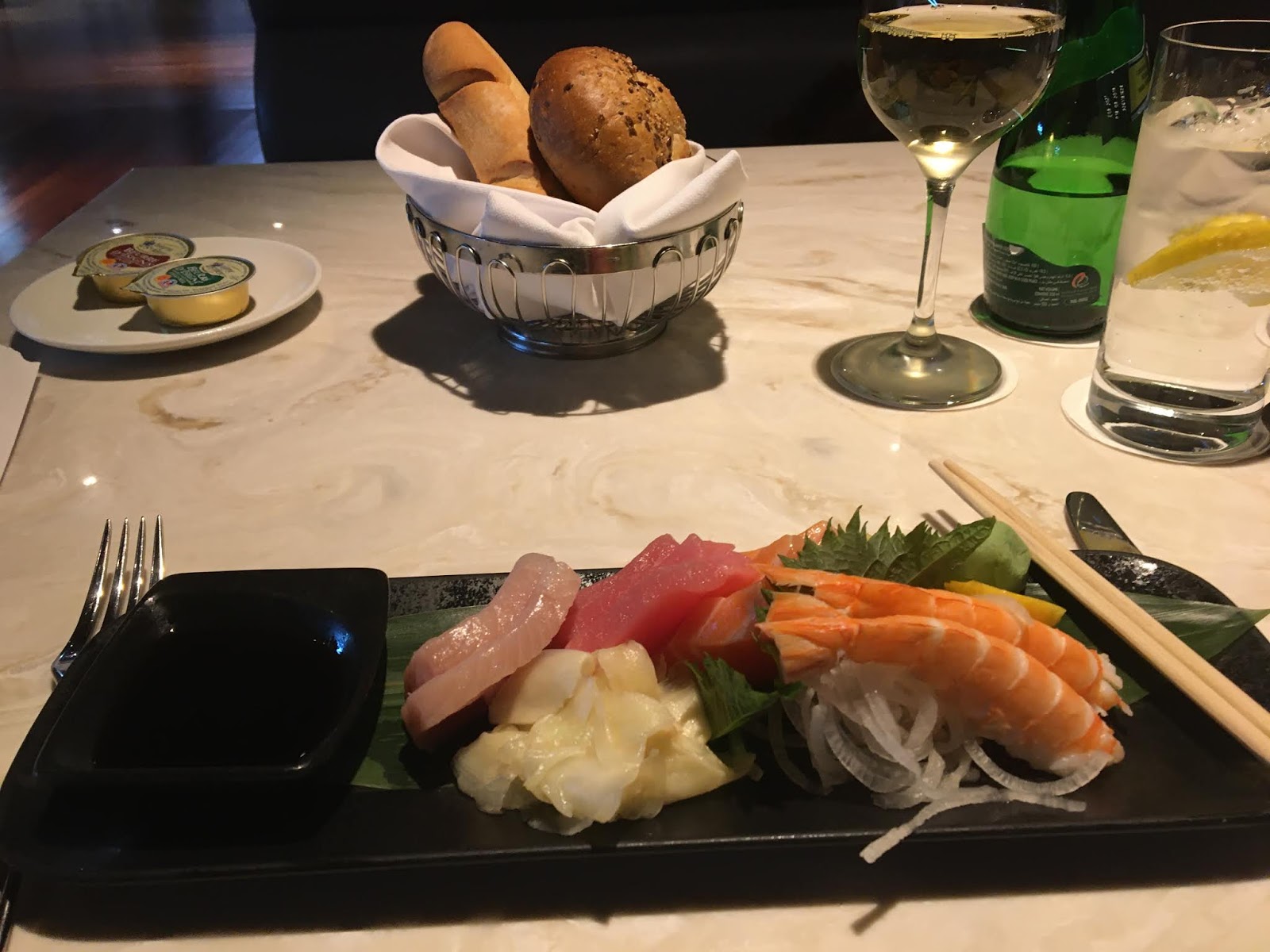
I head to the first class lounge, a vast oasis of calm in an otherwise heaving airport, where the staff outnumber the passengers. I elect to have a la carte fine dining: delicious sashimi to start, veal saltimbocca for main, and a fruit and cheese plate to round it off. As expected, the wine is also excellent. I don’t bother with the spa or cigar room, but I do use the sleep area for a while after a glass of 15-year-old Glenfiddich.
Once on board, the beaming stewardess hands me a hefty goodie bag. Bulgari amenities, gourmet snacks galore, pyjamas for the overnight journey, slippers, moleskin notebook and pen. She offers me a pre-take off drink. I don’t hesitate in my choice: a glass of Dom Perignon 2008 Champagne.

How did I get here?
I’ve done a few business trips to the Middle East and saved up some miles. It turns out that that the Emirates loyalty scheme is not very generous. Surprisingly, BA’s Avios are much better for getting reward flights.
With my working days numbered, and business travel becoming increasingly exhausting, it made sense to use my Emirates points for an upgrade, rather than wait for a reward flight that will likely never come.
So I’m making the most of the absurd luxury while I still can. Things will start changing soon. I will need to cut back further at work, stop the travel, and retire in two or three years with a pension pot that will very much put me at the back of the plane, if indeed I’m on the plane at all.
We will be landing soon. Whilst I enjoy my scrambled eggs and cup of tea, I reflect on the best bit of my journey.
Taking a morning shower at 41,000 feet. Obviously.


Hope fatigue: will there ever be a cure?
Saturday 1 February 2020
At the start of 2020
there was a flurry of posts on various Parkinson’s forums about all the promising
research and clinical trials in progress, not to mention a few puns around “20/20
vision”.
Rather than repeat it all here (and probably get some of it wrong), I would refer you instead to The Science of Parkinson’s take on the topic, The Road Ahead: 2020. It’s a long article so I’ve attempted to summarise the drug trials referenced at the bottom of this post.
Wow. There are a lot of candidate treatments currently being tested, and many threads of more fundamental research also in progress. But we’ve been down this road before.
One thing that Dr Simon Stott alludes to in his post is the idea of “hope fatigue”. Despite the long list of therapies currently in clinical trials, the sobering reality is that the underlying cause of Parkinson’s is not understood, the different types of Parkinson’s are not fully identified or understood and there have been no significant new drugs since the discovery of levodopa and the dopamine agonists in the 1960s. In the last 50 years or so, there have been numerous headlines about promising new medicines that have all come, essentially, to nothing. For long sufferers of the disease, hope fatigue is a very real phenomenon.
Of course, eventually there will be a cure, or at least treatments to improve life with the disease. The human race is too smart, and the collective effort being put into neurodegenerative diseases too great, for us not to figure something out.
The real question is when? Will there be a cure, for example, in my lifetime?
Crystal ball gazing is a hazardous pursuit, but let’s see what the data tells us.
Firstly, let’s look at the amount of Parkinson’s research. A count of research papers on PubMed with the tag “Parkinson’s” reveals that the number of papers published has quadrupled over the last twenty years.

Compared to other neurological conditions, Parkinson’s doesn’t do too badly in terms of the amount of research published. But it is dwarfed by research into conditions like diabetes and the work across different types of cancer or even HIV.

What about funding for research? We would expect this to be correlated with the number of papers published.
After gradual reductions in real terms over recent years of the amount that governments in, for example the UK and the US, have been setting aside for research across all the medical sciences, is on the increase. For example, the United States Congress recently passed its budget for Fiscal Year 2020 which included a $2.6 billion increase for the National Institutes of Health (NIH), bringing the agency’s budget up to $41.46 billion.
However, Parkinson’s only gets a tiny slice of the government research funding pie. More significant is private funding for research. The biggest source for this is the Michael J Fox Foundation. Their annual contribution to Parkinson’s research has increased by 42% over the five years since 2014 (watch out for the slightly misleading scale on the graph). This increase in funding is consistent with the increase in the amount of research output that we saw earlier.

In summary, the amount of research into Parkinson’s is high compared to other neurological conditions and has been consistently growing over recent years, but it is still small compared to many other medical conditions.
Does it deserve more funding? Given the number of people affected, maybe. But in the majority of cases, people can still have a reasonable life for quite a few years with Parkinson’s and it’s a very different story for most types of cancer for example. Or Alzheimer’s for that matter.
What can we learn from other conditions?
AIDS/HIV is essentially resolved from a medical perspective though the antiretroviral drugs used to treat it remain too expensive for many. The total global spend between 2000 and 2015 on the disease was an astonishing $562 billion according to the Institute for Health Metrics and Evaluation (IHME) at the University of Washington. Yes, that’s half a trillion dollars. More than the annual GDP of Thailand with its population of 70 million.
Similarly, research spending on cancer, which has made great progress in the last couple of decades, runs into tens of billions of dollars per year.
The lesson is clear: finding cures for tricky medical conditions requires a lot of funding, way more than Parkinson’s or Alzheimer’s currently receive. We’ll get there in the end but at current levels of investment it will take time.
So, as I gaze very speculatively into my crystal ball, what I see is:
- An ageing population and more people being diagnosed with Parkinson’s every year
- Steadily increasing research funding from governments and private organisations, and a corresponding increase in research output, but at an absolute level lower than many other conditions
- Over the next 10 years, the approval of some drugs that slow progression of the disease for some people
- Over 10-20 years, an understanding of the underlying cause(s) of some variants, and perhaps treatments that can restore missing neurons, thereby reversing the disease
- Over 20-40 years, science starts winning the war, systematically understanding the different variations of Parkinson’s, developing reliable screening for risk factors, and finally finding a cure (or set of cures)
Where does that leave hope?
Given these assumptions, I don’t follow every research thread or get excited at every news headline. But it’s not really a case of hope fatigue. For myself I don’t expect to be cured (and would be pleasantly surprised if this did happen). But I have every hope – indeed expectation – that the next generation won’t have to suffer from the disease that James Parkinson first described 203 years ago.
Table of current trials
Target
|
Drug under
development or in clinical trials
|
Companies/
parties involved
|
| Alpha synuclein
immunotherapy (attacking the build up of alpha synuclein using either the brain’s own antibodies or artificial ones) |
Prasinezumab | Roche, Prothena Biosciences |
| BIIB054 | Biogen, SPARC | |
| MEDI131 | AstraZeneca | |
| Lu AF82422 | Lundbeck, Genmab | |
| BAN0805/ABBV-0805 | AbbVie, BioArctic Neuroscience | |
| AFFITOPE PD01A | AFFiRiS | |
| UB-312 | United Neuroscience | |
| NPT088 | Proclara Biosciences | |
| NPT520-34 | NeuroPore Therapies | |
| NPT200-11 | UCB | |
| ENT-01 | Enterin | |
| YTX-7739 | Yumanity | |
| Mannitol | Clinicrowd | |
| Anle138b | MODAG | |
| LRRK2 inhibitors (for people with a PD-inducing mutation in the LRRK2 gene) | DNL-201 | Denali Therapeutics |
| BIIB094 | Biogen, Ionis Pharmaceuticals | |
| PINK1 and PARKIN inhibitors | TBA | Mitokinin |
| TBA | Vincere | |
| iCP-Parkin | Cellivery | |
| GBA therapies | Ambroxol | Cure Parkinson’s Trust, Van Andel Institute |
| Venglustat | Sanofi Genzyme | |
| LTI-291 | Lysosomal Therapeutics | |
| TBA | Prevail Therapeutics | |
| AVR-RD-02 | AVROBIO | |
| ESB1609 | E-scape Bio | |
| S-181 | Surmount Bio | |
| c-Abi and TORC1 inhibitors (boosting the body’s natural autophagy mechanism) | Nilotinib | Georgetown University |
| K0706 | SPARC | |
| FB-101 | 1ST Biotherapeutics, Neuraly | |
| Radotinib | Il-Yang Pharmaceutical | |
| IkT-148009 | Inhibikase Therapeutic | |
| RTB101 | resTORbio | |
| NLRP3 inhibitors and other anti-inflammatories | Inzomelid | Inflazome |
| NT-0167 | NodThera | |
| Azathioprine | Cambridge University | |
| XPro1595 | INmune Bio | |
| Sargramostim | Parkinson’s Nebraska | |
| GLP-1R agonists (protecting further neurons from dying) | Exenatide | |
| Lixisenatide | ||
| Liraglutide | ||
| Semaglutide | Novo Nordisk | |
| NLY01 | Neuraly | |
| PT320 | Peptron | |
| Neurotrophic factors (growth hormones for neurons) | GDNF | Cure Parkinson’s Trust, Brain Neurotherapy Bio, Genecode |
| CDNF | Herantis | |
| Mitochondria boosters | UDCA | University of Minnesota |
| CNM-Au8 | Clene Nonomedicine | |
| Terazosin | ||
| EPI-589 | BioElectron | |
| CuATSM | Collaborative Medicinal Development | |
| Nicotinamide Riboside | ||
| AMX0035 | Amylyx | |
| Statins (for neuroprotection) | Lovastatin | |
| Simvastatin | PD-STAT | |
| Iron reduction | Defeiprone | Apopharm |
| PBT434 | Alterity Therapeutics | |
| Plasma infusion | GRF6021 | Alkahest |
| Other neuroprotection | Lingzhi | |
| Ceftriaxone | ||
| KM-819 | Kainos Medicine | |
| DA-9085 | Dong-A ST | |
| ANAVEX2-73 | Anavex | |
| Cell transplantation | N/A | Transeuro |
| N/A | International Stem Cell Corporation | |
| N/A | Center for iPS Cell Research and Application | |
| N/A | BlueRock Therapeutics | |
| N/A | Aspen Neuroscience |
Subscribe to:
Posts (Atom)
Popular posts
-
 Monday 26 March 2018 (See also related post: a glass of whisky a day keeps the neurologist away ) A few miles off the A96, halfway bet...
 -
 Wednesday 29 August 2018 My first proper experience of the wholesome delights of rock, grass and earth under boot was in the Yorkshire ...
 -
 Thursday 27 September 2018 A glass of whisky a day keeps the neurologist away. Or does it? Six months ago I embarked on an experim...
 -
Saturday 20 August 2023 Nothing lasts forever, least of all this blog. After about 7 years, 200 posts and 75,000 views, I've decided tha...
-
 Saturday 27 May 2023 My mother and I shuffle slowly along the trails through the woods at the back of her house. Our time together is precio...
 -
Friday 7 July 2023 Four years ago, I wrote about how attending the World Parkinson Congress in Kyoto , Japan, changed my life. This week ...
-
Tuesday 16 May 2023 “FUCK!” I shouted, loud enough for the neighbours several doors away to hear. The IKEA wardrobe I had been strugglin...
-
Friday 3 March 2017 I had my first meeting with The Professor yesterday evening at the private consultation rooms of his hospital in Lo...
-
Saturday 25 February 2023 The C word has only 4 letters but it’s a big word. A word that used to be used in open conversation but is now tab...
-
 Thursday 6 June 2019 I think this week has already changed my life. Wow. What a great event and what a roller coaster week. And to thin...
